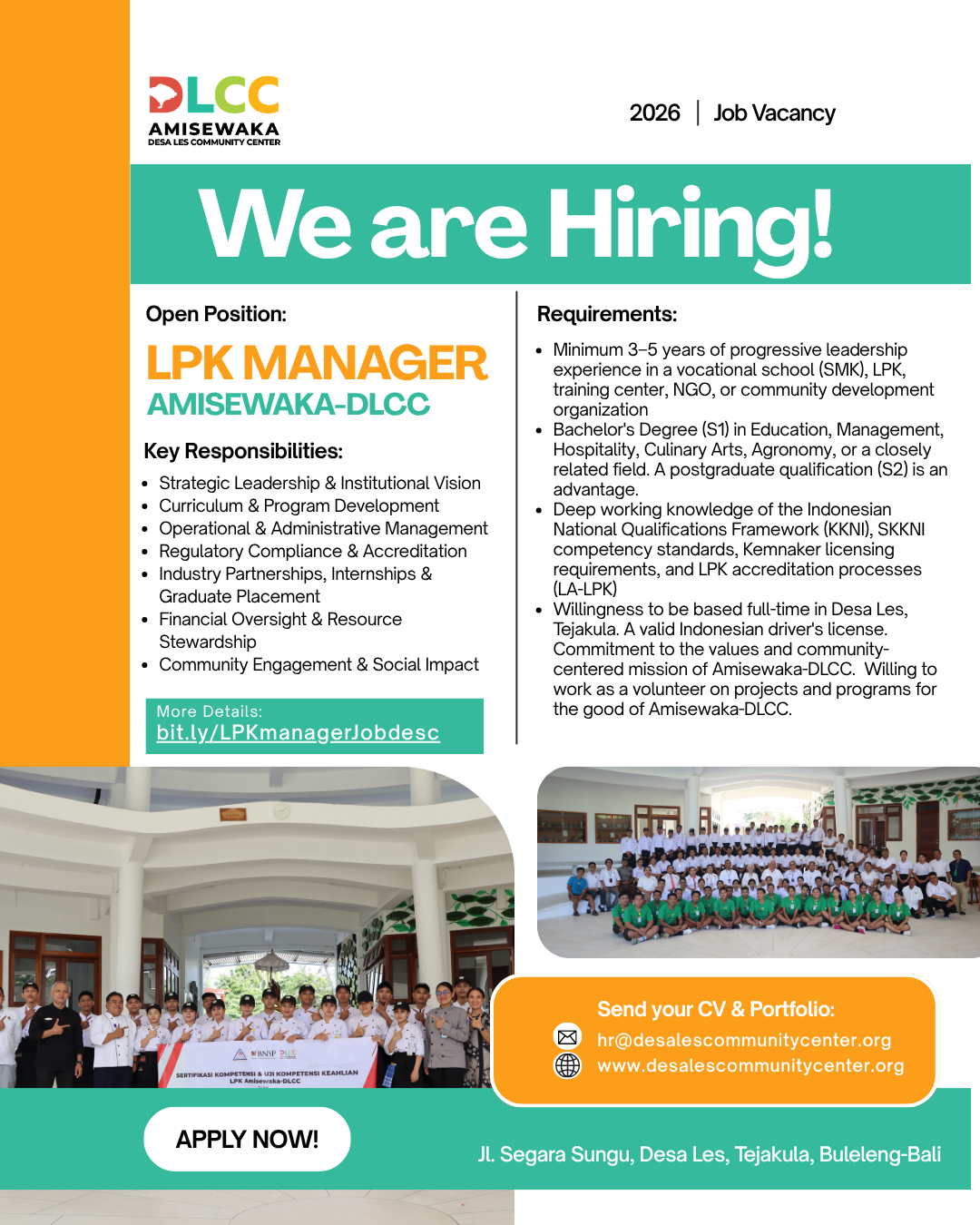
| Position Title | LPK (Lembaga Pelatihan Kerja) Manager |
| Organization | Amisewaka — Desa Les Community Center (DLCC) |
| Location | Desa Les, Tejakula, Buleleng, Bali |
| Reports To | Director / Executive Leadership, Amisewaka-DLCC |
| Employment Type | Full-Time |
| Classification | Senior Leadership / Management |
ORGANIZATIONAL CONTEXT
Amisewaka — Desa Les Community Center (DLCC) is a community-centered organization based in northern Bali, committed to sustainable development, cultural preservation, and economic empowerment. Its Lembaga Pelatihan Kerja (LPK) is a licensed vocational training institution operating under the authority of the Indonesian Ministry of Manpower (Kemnaker), providing certified, industry-relevant skills training to youth and adults in the Tejakula region and beyond.
The LPK Manager provides the highest level of leadership for the institution, driving its educational mission while maintaining regulatory compliance, institutional quality, and community impact.
POSITION SUMMARY
The LPK Manager is responsible for the strategic leadership, operational management, regulatory compliance, and community engagement of the vocational training center. This senior role ensures the LPK delivers high-quality, industry-relevant training across its vocational streams — including Culinary Arts, Hospitality, and Permaculture — while sustaining its licensed status, building industry partnerships, and ensuring measurable impact for the communities it serves.
The LPK Manager acts as the primary representative of the LPK to government bodies, industry stakeholders, community members, and partner organizations, and is ultimately accountable for the institution’s educational outcomes, financial stewardship, and institutional reputation.
KEY RESPONSIBILITIES
- Strategic Leadership & Institutional Vision
- Define and champion the long-term vision and annual strategic goals of the LPK in alignment with the broader Amisewaka-DLCC mission and community development objectives.
- Develop, implement, and review multi-year strategic plans covering program growth, community reach, financial sustainability, and institutional quality.
- Lead internal reviews and continuous improvement cycles, benchmarking the LPK’s performance against national standards and regional peer institutions.
- Cultivate an organizational culture that values professional excellence, community service, cultural sensitivity, and lifelong learning.
- Serve as the principal spokesperson and institutional ambassador for the LPK to all external stakeholders.
- Curriculum & Program Development
- Oversee the design, development, and ongoing refinement of curricula for all vocational streams (Culinary Arts, Hospitality, Permaculture, and any future programs), ensuring alignment with KKNI (Kerangka Kualifikasi Nasional Indonesia) and SKKNI (Standard Kompetensi Kerja Nasional Indonesia) standards.
- Identify emerging vocational opportunities, labor-market trends, and community needs to expand or update program offerings in a timely and responsive manner.
- Ensure all training programs are practically oriented, industry-validated, and designed to maximize graduate employability and entrepreneurship outcomes.
- Collaborate with the Academic Head to schedule classes, manage instructional resources, and monitor program delivery quality.
- Maintain full command of culinary pedagogy and instructional methodology, and be prepared to step in and deliver Culinary Arts classes when instructors are unavailable, ensuring training continuity without disruption to students.
- Operational & Administrative Management
- Manage the day-to-day operations of the LPK, including student recruitment and enrolment, timetabling, facilities management, and resource allocation, in close collaboration with the Academic Head.
- Recruit, supervise, mentor, and evaluate instructional and administrative staff, fostering a culture of professional growth and accountability.
- Establish and enforce standard operating procedures (SOPs) for all aspects of LPK operations, from intake processes to graduation and alumni tracking.
- Maintain accurate and up-to-date institutional records, including student files, attendance, assessment outcomes, and program data.
- Manage vendor and supplier relationships to ensure the timely, cost-effective procurement of training equipment, materials, and consumables.
- Regulatory Compliance & Accreditation
- Ensure the LPK at all times operates in full compliance with Indonesian labor laws, Ministry of Manpower (Kemnaker) regulations, and all applicable national and regional requirements for licensed vocational institutions.
- Manage the LPK’s VIN (Verification Identification Number) and ensure all mandatory reporting through the Sisnaker (Sistem Informasi Ketenagakerjaan) platform is accurate, complete, and submitted on time, in collaboration with the Academic Head.
- Lead and coordinate the institutional accreditation process (LA-LPK), managing all documentation, self-evaluation, and audit preparation in collaboration with the Academic Manager and relevant staff.
- Proactively monitor changes in legislation, ministerial regulations, and accreditation frameworks, and adapt institutional policies and practices accordingly.
- Represent Amisewaka-DLCC at Hilsi meetings, Kemnaker coordination forums, inter-institutional gatherings, and other official events as required.
- Maintain complete and well-organized compliance documentation, ensuring the institution is audit-ready at all times.
- Industry Partnerships, Internships & Graduate Placement
- Develop and maintain a robust portfolio of partnerships with hotels, restaurants, eco-resorts, agribusinesses, NGOs, and other industry stakeholders to provide students with real-world exposure and employment pathways.
- Negotiate, establish, and manage formal Memoranda of Understanding (MoU) or partnership agreements with placement partners, ensuring mutual accountability and alignment with student learning goals.
- Oversee the student internship program (Praktek Kerja Lapangan / PKL), including placement, monitoring, assessment, and de-briefing in coordination with the Academic Head.
- Actively facilitate job placement support for graduates, including career counseling, job-readiness workshops, and referrals to hiring partners.
- Design and maintain a comprehensive alumni tracking system to monitor employment rates, career progression, entrepreneurial ventures, and further education outcomes.
- Use alumni data to inform curriculum relevance, program improvements, and institutional reporting on social impact.
- Financial Oversight & Resource Stewardship
- Develop the LPK’s annual operational budget in consultation with Amisewaka-DLCC leadership, ensuring realistic projections, appropriate allocation, and alignment with strategic priorities.
- Monitor and control expenditures throughout the fiscal year, providing regular budget variance reports to leadership and proactively flagging significant deviations.
- Identify opportunities to diversify revenue streams (e.g., fee-based training, government grants, private partnerships, skills certification services) to support institutional sustainability.
- Ensure cost-effective procurement through competitive sourcing, responsible asset management, and sound financial controls.
- Support the preparation of institutional financial reports and audits as required by Amisewaka-DLCC governance and external regulators.
- Community Engagement & Social Impact
- Act as a visible and trusted community figure, building strong relationships with local community leaders, families, village governance (desa adat and desa dinas), and youth organizations in Desa Les and the broader Tejakula area.
- Champion inclusive access to vocational training, with particular attention to youth from disadvantaged backgrounds, women, and underserved community members.
- Collaborate with local government (Dinas Tenaga Kerja), community organizations, and development partners to align LPK programs with local economic development priorities.
- Represent the LPK’s impact to donors, grant-makers, and Amisewaka-DLCC stakeholders through compelling reporting and storytelling.
QUALIFICATIONS & REQUIREMENTS
| Requirement | Details |
| Education | Bachelor’s Degree (S1) in Education, Management, Hospitality, Culinary Arts, Agronomy, or a closely related field. A postgraduate qualification (S2) is an advantage. |
| Experience | Minimum 3–5 years of progressive leadership experience in a vocational school (SMK), LPK, training center, NGO, or community development organization. Demonstrated experience managing multi-disciplinary teams and programs. |
| Regulatory Knowledge | Deep working knowledge of the Indonesian National Qualifications Framework (KKNI), SKKNI competency standards, Kemnaker licensing requirements, and LPK accreditation processes (LA-LPK). |
| Systems Proficiency | Demonstrated proficiency in the Sisnaker (Sistem Informasi Ketenagakerjaan) and OSS (Online Single Submission) portals. General digital literacy including MS Office or Google Workspace, basic financial tools, and data management. |
| Languages | Fluency in Bahasa Indonesia (written and spoken). Working proficiency in English for partnerships, reporting, and institutional communications. Proficiency in Balinese is a significant asset for community engagement and cultural sensitivity. |
| Culinary Pedagogy | Practical knowledge of culinary arts instruction sufficient to teach or supervise Culinary program classes in the absence of the primary instructor. Formal culinary training or certification is advantageous. |
| Other Requirements | Willingness to be based full-time in Desa Les, Tejakula. A valid Indonesian driver’s license. Commitment to the values and community-centered mission of Amisewaka-DLCC. Willing to work as a volunteer on projects and programs for the good of Amisewaka-DLCC. |
CORE COMPETENCIES
| Competency | Behavioral Indicators |
| Strategic Vision | Thinks beyond day-to-day operations; sets ambitious, achievable goals; translates vision into concrete action plans. |
| Leadership & People Development | Inspires and motivates staff; delegates with clarity; mentors others; holds teams accountable while supporting their growth. |
| Community Commitment | Demonstrates genuine dedication to community uplift and vocational empowerment; understands and respects Balinese culture and local context. |
| Emotional Intelligence (EQ) | Navigates interpersonal dynamics with maturity and empathy; resolves conflicts diplomatically; remains composed under pressure; builds trust across stakeholder groups. |
| Multicultural Effectiveness | Works effectively across cultural, generational, and institutional divides; adapts communication style thoughtfully to diverse audiences. |
| Operational Excellence | Prioritizes rigorously; builds efficient systems and processes; ensures follow-through and accountability at all levels. |
| Integrity & Accountability | Models ethical behavior; transparent in decision-making; takes responsibility for outcomes — both successes and failures. |
| Innovative Problem-Solving | Approaches challenges creatively; draws on evidence and community input; iterates quickly to find practical, context-appropriate solutions. |
WORKING RELATIONSHIPS
Internal
- Director / Executive Leadership, Amisewaka-DLCC — reports to; participates in strategic planning and governance.
- Academic Head — close day-to-day collaboration on curriculum delivery, scheduling, student management, and accreditation.
- Instructional Staff & Trainers — direct line management; provides supervision, guidance, and professional development support.
- Finance & Administration Team — collaborates on budgeting, procurement, reporting, and compliance documentation.
External
- Ministry of Manpower (Kemnaker) and Dinas Tenaga Kerja — primary regulatory relationship; compliance reporting and accreditation.
- Hilsi and vocational sector networks — represents Amisewaka-DLCC at coordination meetings and sector events.
- Industry partners (hotels, resorts, restaurants, agribusinesses) — develops and maintains placement and internship partnerships.
- LA-LPK accreditation body — manages institutional accreditation cycle.
- Desa Les community leaders, village governance, and families — community engagement and outreach.
- Donors, grant-makers, and development partners — institutional reporting and relationship management.
KEY PERFORMANCE INDICATORS
The LPK Manager will be evaluated annually against indicators including, but not limited to:
- Student enrollment targets met or exceeded each academic cycle.
- Graduate employment or enterprise establishment rate (target to be set annually).
- LPK accreditation status maintained or upgraded.
- All Sisnaker reporting completed accurately and on schedule.
- Annual budget variance within approved thresholds.
- Number and quality of active industry partnerships and signed MoUs.
- Alumni tracking database maintained with up-to-date records.
- Staff satisfaction and retention (assessed through internal review).
- Community engagement activities delivered as planned.
Submit your cover letter and CV to hr@desalescommunitycenter.org by 5 June 2026.


